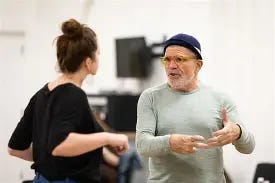
Practical Aesthetics Acting Technique
'Think Before You Act, So You Can Act Before You Think'.

Practical Aesthetics is a relatively new approach to acting. It was developed in the 1980s by the now deeply controversial playwright David Mamet, and it’s taught in New York City at The Atlantic Theatre Company’s headquarters in Manhattan. Mamet and the actor William H. Macy (he of Fargo, Boogie Nights, Shameless and many others) established the company and conceptualised the technique there. Today, Practical Aesthetics is widely taught throughout the US, but perhaps not so much in Europe. Macy describes it as ‘Stanislavski evolved’, and in this article we shall explore what that means in practice. In my view, Practical Aesthetics is, in fact, Stanislavski simplified, but that in no way implies that what might emerge from the application of the technique will necessarily be simplistic. Not at all. What can, and should emerge, are performances of extraordinary truth, authenticity, depth and specificity.
Sanford Meisner tells us that the acting is ‘living truthfully under imaginary circumstances.’; and whilst the aim of Practical Aesthetics is to produce a performance which also embodies this ideal, this vision for great acting work is expressed in a slightly different way. For Mamet, good actors can communicate to the audience an authentic sense of ‘solitude in public’. What that means is that they can just ‘be’ on stage as they would simply ‘be’ in life, even if 300 coughing, whispering people are watching them in a darkened auditorium, in a situation of extraordinary pressure and artifice.
Practical Aesthetics is divided into two core themes: ‘action’ and ‘moment’. ‘Action’ is expressed through ‘script analysis’, which Mamet approaches in a very specific way, whilst ‘moment’ describes the moment-to-moment interaction in the scene between the actors (see my earlier explanations of Meisner to revise this).
Action: Script Analysis
‘The Literal’
At the heart of Practical Aesthetics is the idea that to be a successful actor, you must ‘think before you act, so you can act before you think’. What does that mean? Essentially, it means that you must ground yourself in the facts of the play, and what, precisely, it is that you need to do in the play, before you begin. You need to think and analyse, carefully, what is there on the page. Once you have done that work, then, and only then, can give yourself over to the moment.
The actors begin by reading the scene very carefully and asking themselves this simple question: what am I literally doing here. Unfortunately, the word ‘literally’ has been tossed around in our culture with such abandon that some people still don’t understand what it means, or they use it in a symbolic way.
Parse carefully through all the lines of your scene and work out what it is that you are literally doing. For example, if this were a scene from a play, I would be literally sitting on a chair, typing on a computer, in a room. I am literally writing about Practical Aesthetics. I am also literally listening to Avant-Garde music while I write. The important thing here is that the sentence(s) is simple, straightforward and entirely justifiable based on the evidence of the text. And I can write it out in a sentence or two.
I am literally sitting on a chair, typing, writing about Practical Aesthetics, and listening to Gnossiennes by Erik Satie.
Don’t try asking deeper questions about what you are reading, and don’t offer academic or intellectualised interpretations of the lines. This is not required at all. All that is required, at this stage, is that you state very specifically what you are literally doing.
This stage does not really involve the actor and her interpretive abilities. We are talking here in terms of specific, demonstrable facts. Furthermore, don’t allow what has happened in the past to the character to influence you when writing about what is literally happening, and don’t allow any knowledge of what will happen next to impact you either. Theatre and film performance, like life, unfolds, moment-to-moment, so you don’t want to think about acting in a way that’s going to take you out of the present. And, of course, you don’t act your literal: it is simply a way of grounding you in the facts of the imaginary circumstances.
The Want
Like Stanislavski’s concept of the objective, ‘The Want’, in Practical Aesthetics is simply the goal that want you to achieve in this interaction. It justifies why you are having this conversation or what you are doing, its purpose. Again, look at the lines of the script and identify what your ‘Want’ is based on the evidence of the text. Look carefully at every line and then select your ‘Want’. This is the moment when you, as the actor, can make an interpretation of what you are reading. What is your motivation in the scene?
But, again, you must keep it simple and grounded in truth and the facts that you encounter on the page. For example, if we are taking my writing of this article as a scene, we could say that my ‘Want’ is to write an engaging article that will teach you about Practical Aesthetics, so that you will learn more about acting. And, although there may be other reasons or ‘Wants’ behind what I’m doing, that ‘Want’ is simple and entirely justifiable.
I want to write an engaging article about Practical Aesthetics so that you will learn more about acting.
If the Literal is a simple statement of observable fact, the Want takes us a step further, creating a sense of direction and momentum for the character. However, we must caution ourselves to stay as faithful as possible to the writer and to their vision. Do not deviate from what is there, and from what you find. One of the purposes of script analysis in Practical Aesthetics is to teach the actor the importance of identifying precisely what has been written. The ‘Want’ is the point at which the actor’s interpretation and the writer’s text meet for the first time. It provides the basis for the next step: action.
In the next article, I’m going to explain how Practical Aesthetics views the next step, ‘action’, and we’ll take a closer look at Mamet’s conceptualisation of the As If, as well.
James Jarrett