The Meisner Technique
So that you actually understand it

This is the first in a series of articles that will explain The Meisner Technique in a way that will help you understand it properly. The Meisner Technique is practiced across the industry in the UK and US today, and all actors are expected to be capable of using the technique’s principles on stage and screen.
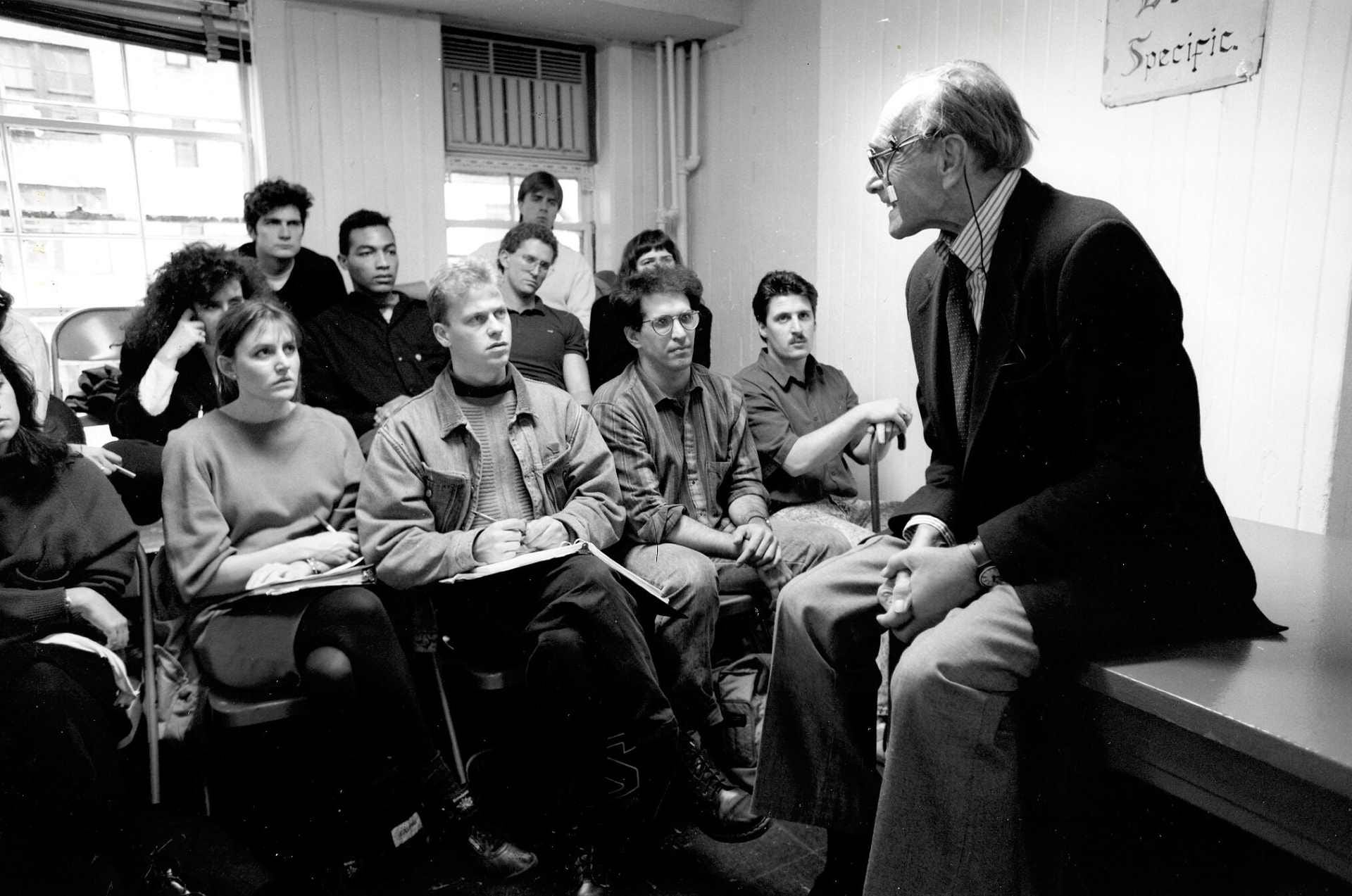
Sanford Meisner was a member of the Group Theatre in New York, with Stella Adler, Lee Strasberg and Harold Clurman (more on Adler and Strasberg in due course). The group was established to explore and investigate Stanislavski’s ‘Method of Physical Action’ in America. When the group split up, Meisner spent a lifetime developing and refining the exercises and theory that I’m going to describe and explain to you here. He taught at the Neighbourhood Playhouse in New York, and in his later years, he divided his time between the City and the Caribbean, where he had a house, and lived with his partner, James Carville.
He was famously afflicted by cancer of the throat, and after many operations on his larynx, had to learn to speak by burping up the air in his stomach. He also endured a horrible accident when he was hit by a van in New York, and he was nearly killed when he drove his car off a cliff on the island of Bequia.
Meisner’s approach to acting is a simple, unfussy technique which is predicated on the need to solve two basic problems: actors don’t listen and they are self-conscious. In a nutshell, Meisner’s solution is for actors to learn to place their attention on the other person in the scene, but there is so much more to it than that, as we shall discover.
When reading Meisner, you quickly realise that he has addressed these problems not from an artistic perspective, but in the way that a carpenter might apply practical, ‘hands on’ logic to engineer a table or chair. The repetition exercises build one upon the other, and ‘snap’ together, piece by- piece, to form the technique, which is user friendly and rooted in common sense. Put simply, Meisner saw acting as making, building, constructing. He once told a student that “When you create a character, it’s like making a chair, except instead of making something out of wood, you make it out of yourself”.
That being said, everything in Meisner is dependent on an actor responding from their gut. Your instincts are the impulses that come to you in a split second when you hear or see something, before your civilised mind jumps in to rescue you from the shocked gaze of the people who surround you. It is a spontaneous response that you don’t even know about until it’s happened, and it comes from deep within you. It comes from the animal part of your brain that hasn’t really evolved much in thousands of years. And animals are driven by instinct, not thought
Wherever I go these days, I see images of Meisner (well, you would if you worked in drama studios) and his pithy quote that ‘Acting is living truthfully under imaginary circumstances’ is always emblazoned somewhere, on a poster, on a leaflet, on a website. But what does that actually mean?
It basically means that you behave like a real person in a situation that you know isn’t real, (i.e the play or the film). But: you can’t just do that, nobody can. ‘Living truthfully under imaginary circumstances’ is the end goal, the outcome, the destination that is bestowed on those who practice and master the Meisner Technique. What it means in practice is that one day you will be standing on a stage, or in front of a camera, and everything that you do or say will be real and truthful because it came from within you - and not from the pen of the writer or the instructions of the director.
First Stage Repetition
The Meisner Technique is about the contact between us and how that changing contact keeps changing us. I don’t how I could put it any better than that.
Its central revelation is that acting is not about actors doing things to make the play work. On the contrary, it’s about you abandoning all attempts to control or direct your performance, and instead allowing your instinctual responses to the behaviour of other people to take over.
In the first stage you simply sit opposite one another, and you go back and forth, back and forth, one actor after another, pointing out something about the other actor that you see. It’s a game of verbal ping pong, and you do it without thinking.
Actor A: You’ve got a black shirt on
Actor B: I’ve got a black shirt on.
Actor B: Your hair is blond
Actor A: My hair is blond
etc….
Over time, as you go back and forth - and as you do nothing but repeat what you hear - the repetition will begin to change. It will develop. It will move. And you will feel this shift within you, you will hear it and you will sense it. You know it’s happening, but you can’t put your finger on why it’s happening. It just is. And, (and this is absolutely crucial) you follow the repetition without expectations, judgments, or beliefs. You just follow what is happening and you keep repeating what you are hearing. You don’t have time to think, or analyse, or explain. You let it happen.
Now: neither of you is outwardly or consciously doing anything to force that change, or create it, or shape it, or make it happen. It just happens naturally, organically, spontaneously. The repetition is alive, it goes where it wants to go, it moves where it wants to, it drifts, changes and shifts: moment- to- moment.
Furthermore, you go back and forth at speed, leaving almost no time whatsoever to think your way through the exercise. If you slow down, you’re giving that civilised, thinking part of the brain a chance to jump in and start blocking the messages coming from your impulses. This will break the process down because the exercise needs truthful impulses to work. When you feel that you are hearing the truth, you will be truthful in response.
Most actors find this first exercise extremely difficult to master. They are so desperate to jump in and change it, or shape it, or do something to force it, that they start pushing for solutions to make the scene come alive or become interesting to watch. They find the repetition boring, mechanical, absurd or frustrating, or they just don’t get it, and that’s entirely understandable. But, if you are practising Meisner, you must teach yourself not to try and find solutions to the repetition. If you’re thinking this way towards the exercise, then you still don’t trust your instincts to do their job - yet. You’re trying to ‘problem solve’ your way out of the problem, but you don’t need to, and it won’t help. Your conscious, reasoning mind won’t help you at all. In fact, it's your enemy. You need to relax, listen and let it happen to you.
This first exercise is the foundation, or the building block of the technique, and once you can see the bigger picture, it makes perfect sense why it would be. The exercise teaches you to shut off the thinking, planning, critical part of your brain and instead to activate that part of yourself that knows and feels through intuition.
You learn to listen like a hawk, but you are not doing it in a way that feels forced or ‘showy’. You’re not saying “hey, look, you asked me to listen, so now I’m listening!”.You’re learning to listen with your gut and your instincts. You follow as the repetition changes, and you can do this because - and it is absolutely essential that you grasp this - you are absolutely open to accept and be changed by what you hear. Your partner is also in the same state of openness. The two of you enter this ‘dance’ of repetition, surrendering to the moment, back and forth, back and forth, doing nothing but being affected by, and responding to, what you hear. Watching the actors work in this way, it feels almost as if they are tethered together by an invisible chord.
The exercise teaches you to put your attention on the other actor and to work off of what you see in them. In Meisner, you always, always, go back to what you see in the other person that’s in front of you. You never drift off into abstract thoughts in your own head. And if you do, you always bring it back to the behaviour of the other actor. This is extremely empowering for actors because it gives you something to hold onto, something to do when you are under extreme pressure: watch what the other actor is doing and respond.
But why? you might ask. What is the purpose of this? The purpose is to give you a first insight into how people actually talk. Not stage talk, or actor talk, or how you think they talk, but real conversation. And if we want to reach a stage where you are ‘behaving truthfully under imaginary circumstances’, firstly we have to understand how people actually behave when they interact.
Great James. I think we were doing a version of that with our Voice session? Bernard